The Framework
Project Intent is the philosophy. OrgOS is the operating architecture. Together they shorten the distance between intent and evidence.
The Problem
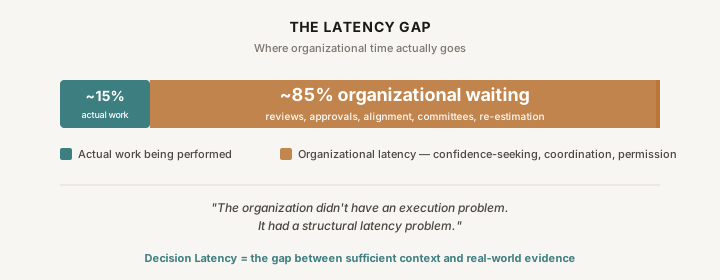
Most organizations don't have an execution problem. They have a structural latency problem. The work happens fast — but the permissions, reviews, and alignment rituals that surround the work consume orders of magnitude more calendar time than the work itself.
The Mechanism
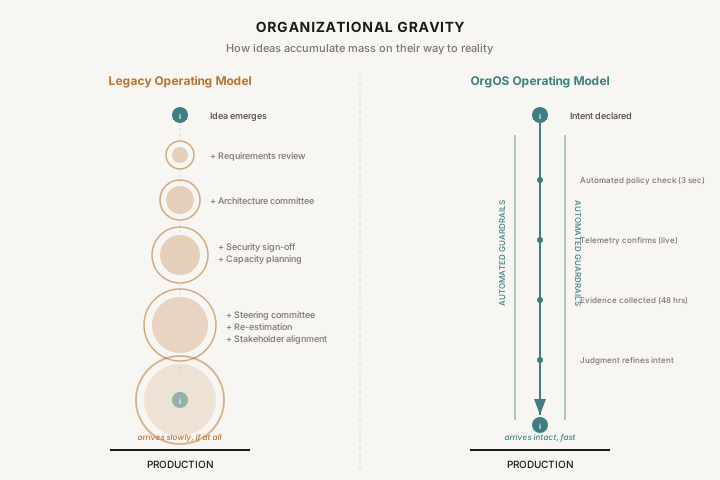
In a legacy operating model, every idea accumulates organizational mass on its way to production. Each layer of review, approval, and alignment adds weight. In the OrgOS model, safety comes from the environment — automated guardrails — not from human checkpoints. The idea arrives intact.
The Runtime
OrgOS replaces the predict-then-execute cycle with a continuous loop: declare intent, execute immediately, collect real evidence, and let that evidence refine the next decision.
First Principles
I — Reality
1. Every methodology is an optimization for the dominant constraint of its era.
When the constraint changes, the methodology becomes a structural liability.
2. Every technological advance that creates abundance exposes a new scarcity.
Leverage shifts away from the resource that has become cheap and moves into the asset that remains rare.
3. Abundant intelligence amplifies both clarity and confusion.
Automation optimizes the objective it is given with absolute fidelity, without questioning the destination.
II — Economics
4. The bottleneck never disappears. It moves.
Eradicating the friction of execution exposes the underlying latency of decision-making.
5. Intent is more durable than implementation.
Mechanics are disposable run-time logic; intent is the immutable anchor.
6. Implementation has become abundant. Misalignment hasn't.
The quality of an automated answer can never exceed the clarity of its destination.
III — Organizations
7. Planning produces predictions. Execution produces evidence.
Predictions prepare organizations for possible futures; evidence reveals which future actually arrived.
8. Coordination is the price we pay when context is distributed.
Meetings are evidence that knowledge is fragmented.
9. Leadership governs perimeters and intent, not localized execution choices.
The role of leadership changes from supervising tasks to engineering the environment within which work occurs.
IV — Intelligence
10. Human value moves upward in abstraction as machine capability increases.
When execution becomes a commodity, human mastery transitions entirely into systemic judgment.
11. Authority and accountability must grow together, anchored by demonstrated evidence.
Autonomy expands close to the work as the individual demonstrates repeated alignment with the enterprise contract.
12. The objective is never reckless speed; it is better decisions with less unnecessary delay.
An intelligent enterprise functions as a learning engine, measured by the distance between intent and telemetry.
Reality still charges full price for learning.
The Operating Environment
Every enterprise runs on an implicit operating model — unwritten rules governing how decisions get made, how authority flows, and how risk is managed. Most of these rules were engineered for an era when execution was expensive and scarce.
OrgOS is the name for an operating environment designed around the economics of abundance. An organization achieves modern velocity only when its structural environment matches the economics of its tools.
The Six Pillars
- 1. The Scarcity Shift
- Transition resources from the execution layer (abundant) into the human judgment layer (the modern constraint).
- 2. Decision Latency
- Minimize the time between acquiring sufficient context to act and actually committing to live reality.
- 3. Bounded Governance
- Replace human permission loops with system-enforced, automated perimeters.
- 4. The Amplified Sovereign
- Enable capable individuals to own a full outcome — from intent through deployment — without waiting for five other teams to approve their work.
- 5. Capacity Funding
- Fund stable execution engines rather than speculative project roadmaps.
- 6. The Evidence Loop
- Govern through unvarnished production telemetry rather than aggregated status reports.
In the Book
The complete architecture — including the OrgOS implementation blueprint — is detailed in Optimized for Yesterday. The book connects these principles into a unified operating model across ten chapters.
Implementation
Self-guided implementation tools — including the Decision Latency Assessment, the Isolation Diagnostic, and the Capacity Reallocation Protocol — are in development.
Get in touch if your organization is navigating this transition now.